

How to Start Performing Laparoscopic Cholecystectomy After Open Training
Transitioning from open to laparoscopic surgery? Learn the exact training steps, skill gaps to close, and how The Medicity’s FMAS/DMAS program gets general surgeons operating safely.
If you have completed open surgery training and now want to transition to laparoscopic cholecystectomy, the fastest and safest path is a structured hands-on fellowship or diploma programme in minimal access surgery — not self-taught practice in theatre. A formal training pathway closes the specific skill gaps that open training does not cover: 2D psychomotor adaptation, instrument triangulation, and critical view of safety under laparoscopic optics.
This guide is written specifically for general surgeons. It covers exactly what you need to unlearn, relearn, and practise before you can safely perform a laparoscopic cholecystectomy independently — and how The Medicity’s fellowship and diploma in minimal access surgery training provides that structured transition.
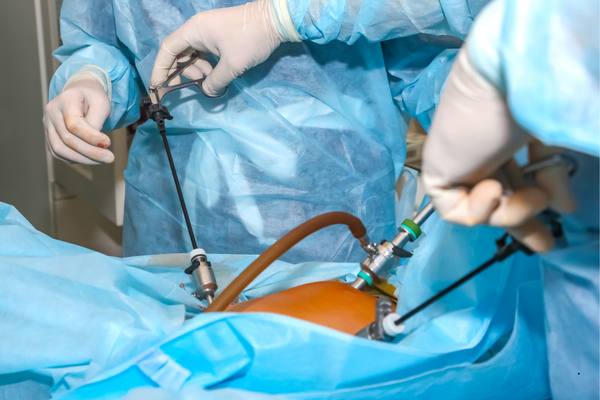
Why Open Training Is Not Enough for Laparoscopic Surgery
Open cholecystectomy and laparoscopic cholecystectomy are the same operation anatomically, but they are entirely different surgically. Open training builds your understanding of biliary anatomy, tissue planes, and haemostasis — all of which are directly transferable. However, it does not prepare you for:
- Reversed fulcrum effect — instruments pivot at the port; movement on screen is opposite to hand movement
- 2D depth perception — judging tissue thickness, clip placement depth, and duct diameter without tactile feedback
- Trocar placement and abdominal access under pneumoperitoneum
- Energy device safety — monopolar and bipolar use near the bile duct
- Port-site management and extraction without wound extension
The 5 Core Skill Gaps Open Surgeons Must Close
Skill Gap | Why It Matters in Lap Chole | How to Close It |
|---|---|---|
Psychomotor coordination | Instruments move on a 2D screen; hand-eye recalibration takes 10–15 operative hours | Simulation trainer drills 4–6 hrs/day for 5 days minimum |
Camera navigation | Surgeon must direct scope while operating — unfamiliar role for open-trained hands | Dedicated scope-handling sessions with a trainer |
Critical View of Safety (CVS) | The #1 cause of bile duct injury — must be confirmed laparoscopically before clipping | Live case observation x10 before independent clipping |
Intracorporeal bleeding control | Compression with swabs is not possible — must control with energy or clips endoscopically | Skills lab on haemostasis models + live case supervised practice |
The Step-by-Step Training Pathway for General Surgeons
The safest and most widely recognised pathway for transitioning from open to laparoscopic cholecystectomy follows a structured 4-phase model:
Phase 1 — Cognitive Foundation (Days 1–2)
Study laparoscopic anatomy: hepatocystic triangle, CVS landmarks, anatomical variants
Review video library of 10+ laparoscopic cholecystectomy cases
Understand pneumoperitoneum physiology and contraindications
Study energy device physics: harmonic scalpel, monopolar, bipolar safety zones
Phase 2 — Simulated Skills Lab (Days 2–4)
Box trainer tasks: peg transfer, ring relay, intracorporeal suturing
Scope navigation exercises (30° vs 0° optics)
Clip application on simulated duct models
Tissue dissection on porcine liver models
Phase 3 — Supervised Live Theatre (Days 4–7)
Observe 5 live cases in full — active case discussion after each
Assist as first assistant — handle scope, retract Hartmann’s pouch
Perform specific steps under direct supervision: port placement, Calot’s dissection
First supervised independent case: simple, non-inflamed fundus-first if needed
Phase 4 — Mentored Independent Practice (Week 2)
2–3 independent cases with trainer scrubbed and available
Structured debrief after each case: decision points, CVS confirmation, timing
Case log certification for surgical council records
Related Courses at The Medicity
Fellowship & Diploma Minimal Access Surgery- Dedicated for General Surgeons
Fellowship vs Diploma in Minimal Access Surgery — Which Is Right for General Surgeons?
The Medicity offers two structured programmes for general surgeons seeking laparoscopic training. The right choice depends on your current experience level and the breadth of procedures you want to add to your practice.
Fellowship (FMAS) | Diploma (DMAS) | |
|---|---|---|
Duration | 1 week (intensive, immersive) | 2 weeks (broader scope) |
Best for | Surgeons who want to add laparoscopic cholecystectomy & appendectomy to practice quickly | Surgeons building a full MAS general surgery list including hernia, colorectal, bariatrics |
Hands-on cases | Minimum 5 supervised live wet lab cases + skills lab | Minimum 10 supervised live wet lab cases across multiple procedures |
Cholecystectomy focus | Core focus — 3 dedicated cholecystectomy sessions | Included + extended to complex cases (Mirizzi, acute cholecystitis) |
Certificate | Fellowship in Minimal Access Surgery | Diploma in Minimal Access Surgery |
What Makes The Medicity's MAS Training Different for General Surgeons
The Medicity is India’s #1 surgical training institute, accredited for hands-on laparoscopic education. The fellowship and diploma in minimal access surgery training at The Medicity is specifically structured to address the transition from open to laparoscopic surgery — not just teach laparoscopy from scratch.
Real OR Training — Not Just Simulation
Every trainee at The Medicity operates in a functioning operation theatre on real patients. You are not working on models or simulators alone. This is the single biggest differentiator from online courses or workshop-only programmes.
Faculty With 10,000+ Laparoscopic Cases
Training is conducted by faculty who have personally performed more than 10,000 laparoscopic procedures each. Mentorship is one-to-one in theatre — not group observation. Your faculty scrubs with you, guides your dissection, and debriefs your decision-making after each case.
Cholecystectomy-Specific Curriculum Module
For general surgeons, the programme includes a dedicated laparoscopic cholecystectomy module covering:
- Port placement strategies (3-port vs 4-port, single-incision options)
- Fundus-first vs retrograde dissection techniques
- Critical View of Safety — identification and documentation protocol
- Intraoperative cholangiography technique and interpretation
- Managing acute cholecystitis and Mirizzi syndrome laparoscopically
- Bile duct injury prevention, recognition, and immediate management
- Conversion criteria and technique
elit tellus, luctus nec ullamcorper mattis, pulvinar dapibus leo.
Case Volume and Certification
The Medicity ensures every trainee completes the minimum case volume required for independent practice certification. Your case log is maintained and provided as a formal document — essential for hospital credentialing and medico-legal purposes when you return to your own practice.
Career Impact: What Changes After You Complete FMAS or DMAS
For general surgeons in private or hospital practice, adding laparoscopic cholecystectomy to your scope of practice has immediate financial and professional impact:
Before FMAS/DMAS | After FMAS/DMAS at The Medicity |
|---|---|
Referring laparoscopic cases to other surgeons | Performing lap chole independently in your own OT |
Limited to open general surgical list | Full MAS general surgery list: lap chole, appendectomy, hernia |
No credentialing documentation for lap procedures | Certified case log + fellowship/diploma certificate for hospital privileging |
Patients seeking laparoscopic surgery going elsewhere | Retaining patients within your practice for minimally invasive procedures |
No medico-legal backing for laparoscopic cases | Documented structured training for medico-legal protection |
Frequently Asked Questions
Can I start performing laparoscopic cholecystectomy after just a fellowship?
Is open surgical experience helpful or does it slow down learning laparoscopy?
How many laparoscopic cholecystectomy cases do I need to do before I am considered competent?
What is the Critical View of Safety and why is it the most important step in lap chole?
Does the fellowship and diploma in minimal access surgery training at The Medicity accept international surgeons?
What is the difference between FMAS and DMAS for a general surgeon specifically?
Not sure which course to choose?
Ask Sia — our AI counselor answers your questions about fees, duration, eligibility & career outcomes instantly.